

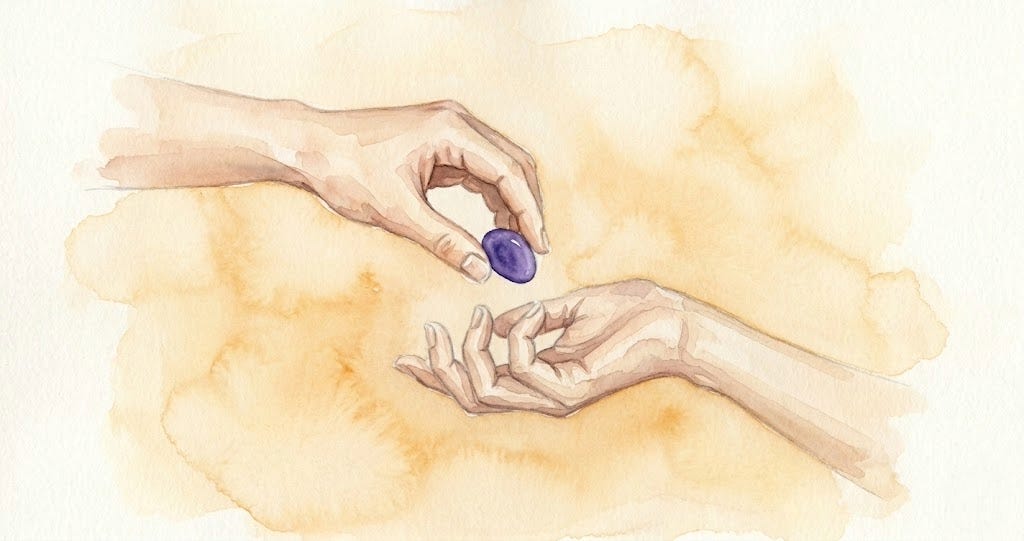
I want to describe a specific kind of professional.
They are the first to offer. The last to ask. They give help fluently, proactively, often before the other person has found the words to say what they need. They read the room, anticipate the difficulty, step in.
And then someone tries to help them. And something shifts.
They over-explain why they need it. They minimise what they actually need. They thank the person more than the gesture warrants. And within moments of the help being offered, they are already calculating what they can do in return.
None of this looks like a problem. From the outside it looks like consideration, gratitude, relational intelligence. But underneath it, something is working quite hard to make sure the help doesn’t fully land.
It is not pride
Pride would be obvious. You would feel it — the sting of being seen as someone who needs something, the resistance of the ego.
This is quieter than that. It doesn’t feel like pride. It feels like being practical, being efficient, being someone who doesn’t make unnecessary demands on other people.
But it is a belief. And the belief runs something like this: I am the kind of person who handles things. Needing help is a departure from that. And departures from that feel, if not dangerous, then at least like information I would rather not transmit.
The belief is rarely conscious. It has usually been operating for long enough that it simply feels like character. I’m independent. I prefer to do things myself. I don’t like asking. These feel like facts about personality. But they are conclusions drawn from a particular kind of environment, reinforced over time.
Where it comes from
High-achievement environments reward self-sufficiency.
The person who figures it out alone. Who doesn’t need their hand held. Who handles the problem without escalating it. Who delivers without needing much from anyone.
Over years, this shapes what feels safe. Needing help doesn’t just become uncomfortable — it becomes associated with a version of yourself you are trying not to be. Less capable. Less reliable. More burden than asset.
And so the reflex forms: handle it. Work it out. Don’t ask.
The reflex is fast. It fires before the conscious mind catches it. By the time you’re aware you’re minimising someone’s offer of help, the deflection is already happening.
The cost that goes unnamed
The obvious cost is exhaustion. Carrying more than you need to carry, for longer than necessary, because you made it difficult for anyone to actually share the load. That is real and it compounds.
But there is a quieter cost that takes longer to name.
The professional who cannot receive help cannot fully connect.
Connection requires showing where you are not whole. It requires the kind of vulnerability that comes from actually needing, and actually being given to, without immediately balancing the ledger. The person who is always the one who handles things, always the one who gives and rarely the one who receives — they are kept at a specific kind of distance from the people around them. Not because anyone chose that distance. Because the system they built to manage their own discomfort with need has that distance as its natural output.
The relationships stay warm. The care is genuine on both sides. But something stays at the surface. The people who want to help them sense, without quite knowing how to name it, that there is a door that doesn’t open. And eventually most people stop knocking.
Three signals that this is happening
These are not diagnoses. They are moments worth pausing at.
You over-thank when someone helps you. Not because you don’t mean it — you do — but the thank you is doing extra work. It is managing the imbalance, signalling that you are aware of the debt, trying to reduce it through the currency of expressed gratitude.
You preface any request with excessive justification. Before you even get to what you need, you have explained why you need it, acknowledged that it is an imposition, noted that you understand if it isn’t possible, and provided three alternative options. The request is surrounded by so much scaffolding that by the time it arrives, it barely resembles a request.
You think about what you can do in return before the help has actually landed. The offer is made. And your immediate internal response is not relief or gratitude but calculation. What does this create? What do I now owe? How do I make this even?
None of these are failures. They are patterns. And patterns, once named, can be worked with.
What actually helps
Not asking for help more. That is often where this conversation goes, and it misses the point.
The difficulty is not in asking. It is in receiving — in letting the help actually arrive, without managing it away. The ask might happen. And then the help is offered. And everything that follows is a set of reflexes designed to ensure that the help doesn’t create an imbalance, doesn’t mark you as someone who needs things, doesn’t change how you see yourself or how you imagine others see you.
The practice is in the receiving, not the asking. It is in noticing the moment the reflex fires — the over-thank, the calculation, the minimising — and choosing, on that occasion, not to act on it. To let the help land. To let it matter. To let the person who offered it feel that they actually reached you.
This is harder than it sounds because the reflex is fast and the discomfort is real. But the discomfort is not a signal that something is wrong. It is the unfamiliarity of a different position. The position of being, for a moment, the one who needed.
There is nothing wrong with that position. You have been the other one for a long time. It might be worth trying this one.
Before you go — one question: what is the last time someone offered to help you and you said no, when actually you could have used it? Reply to this email. I read everything.
Ricky
